
We use cookies on our website to give you an improved browser experience. View our Privacy Policy for more information. Please make your selection to opt in or out of ALL cookies here: Accept or Decline
Global sourcing can make a Natural Specimen collection more diverse, credible, and visually compelling. Buyers may discover mineral formations, responsibly collected shells, botanical samples, or geological materials unavailable locally. Each piece carries evidence of its origin, condition, and handling history. That evidence matters.
Experienced sourcing teams inspect specimens through clear photographs, weight records, dimensions, and condition reports. A small crack around a fossil edge can change its value significantly. So can unclear labeling. Reliable suppliers provide collection details, invoices, export documents, and permissions required by applicable laws. When protected species or regulated materials are involved, professional buyers verify current CITES requirements and national regulations before purchase. Compliance cannot be assumed.
It starts with questions.
A responsible process also considers community benefits and environmental impact. Suppliers should explain who collected the material, where it was found, and whether collection disturbed a protected site. Independent verification, supplier references, and consistent documentation strengthen trust. However, no checklist removes every risk. Photographs can hide restoration, and historical records may be incomplete. This is where careful judgment remains essential. Buyers should pause when a price seems unusually low or an origin story sounds too perfect. Natural Specimen sourcing is not merely a purchasing task. It is a long-term practice built on expertise, traceability, ethical decisions, and honest communication. Mistakes may still happen. The goal is to identify them early, correct them openly, and improve every future sourcing decision.
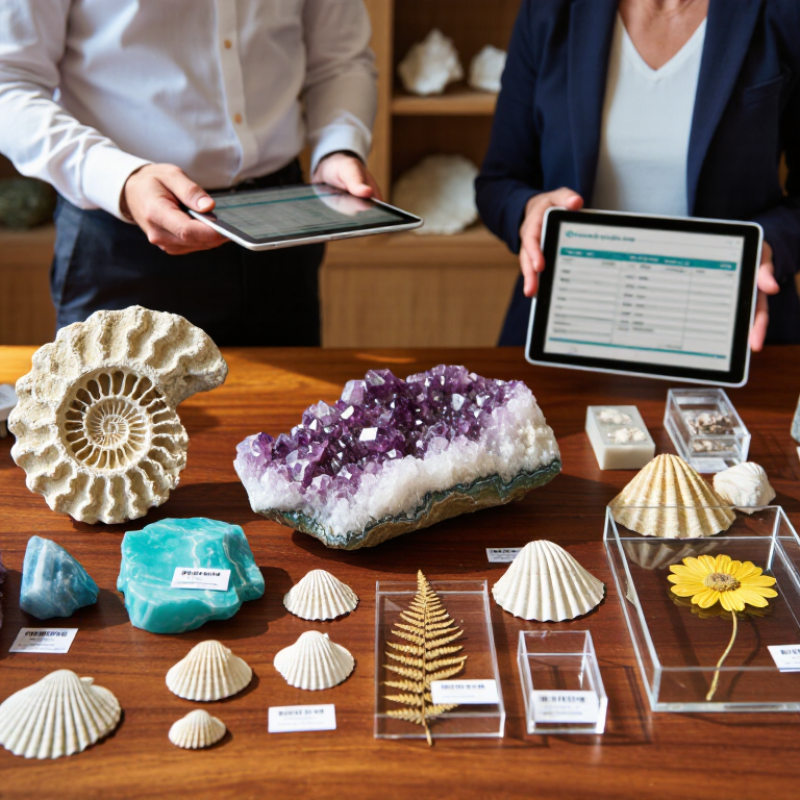
Natural specimens are materials collected from nature and preserved for study, education, design, or reference. They may be biological, geological, or ecological. Biological specimens include pressed leaves, shells, bones, and preserved insects. Geological specimens include rocks, minerals, and fossils. Each category needs different identification and handling methods.
Classification should begin with origin. Is the specimen wild-collected, cultivated, or commercially recovered? Preservation matters too: dried, mounted, embedded, or stored in liquid. Risk classification is equally important. Some species require permits, phytosanitary documents, or CITES-related checks. The IUCN Red List reported more than 46,000 threatened species in 2024, showing why species-level verification cannot be optional. Small errors can create serious sourcing problems.
Reliable suppliers should provide a scientific name, collection date, country of origin, and chain-of-custody records. A clear label helps. For geological items, records should describe location, material type, and recovery method. GBIF’s public biodiversity data network has passed three billion occurrence records, supporting stronger comparison and taxonomic review. Yet databases are not perfect. Names change. Local records may be incomplete. Buyers should request photographs, examine physical condition, and consult qualified specialists when identification remains uncertain. That extra step often costs less than correcting an inaccurate shipment.
| Classification | Representative Examples | Common Physical Form | Key Identification Features | Typical Preservation Method | Global Sourcing Considerations |
|---|---|---|---|---|---|
| Botanical Specimens | Pressed leaves, flowers, seeds, fruits, wood sections, and plant fibers | Dried, pressed, mounted, or preserved in a container | Leaf arrangement, venation, flower structure, seed shape, surface texture, and botanical name | Air drying, pressing, desiccation, or controlled storage away from moisture and direct light | Verify lawful collection, plant-protection requirements, quarantine rules, and any restrictions on protected species or seeds |
| Entomological Specimens | Butterflies, moths, beetles, dragonflies, and other preserved insects | Pinned, spread, dried, or stored in resin or alcohol | Wing pattern, body segmentation, antennae, leg structure, scale arrangement, and specimen label | Dry preservation in insect drawers, sealed display cases, or liquid preservation for selected specimens | Check collection permits, species identification, export documentation, pest control, and restrictions applying to protected insects |
| Zoological Specimens | Feathers, shells, bones, teeth, antlers, eggshells, and naturally shed materials | Cleaned, dried, articulated, mounted, or individually packaged | Morphology, surface pattern, anatomical structure, dimensions, weight, and documented origin | Dry cleaning, dehydration, stabilization, sealed storage, or temperature-controlled preservation | Wildlife-trade laws may restrict many animal parts; confirm species status, legal acquisition, permits, and import requirements before purchase |
| Geological Specimens | Minerals, rocks, crystals, ores, volcanic materials, and polished geological sections | Hand samples, cut slabs, polished pieces, crystal clusters, or thin sections | Color, luster, hardness, crystal form, cleavage, grain, density, and geological locality | Dry storage, protective wrapping, vibration control, and humidity management for moisture-sensitive minerals | Review extraction permissions, local heritage rules, customs classification, weight limits, and safe packaging for fragile materials |
| Paleontological Specimens | Fossilized shells, plant fossils, trace fossils, fossil bones, and amber containing inclusions | Rock matrix, prepared slabs, casts, fragments, or stabilized display pieces | Fossil morphology, geological formation, stratigraphic context, matrix type, and locality records | Dry, vibration-resistant storage; fragile pieces may require reversible conservation materials | Ownership and export rules vary widely by country; request provenance, legal title, excavation records, and relevant permits |
| Marine Specimens | Seashells, coral fragments, echinoderm tests, marine sediment, and dried algae | Cleaned, dried, bleached only when appropriate, mounted, or stored in sealed containers | Shell architecture, radial symmetry, growth lines, spines, surface texture, and collection locality | Rinsing, gradual drying, dry storage, and protection from salt residue and excessive humidity | Coral, shells, and other marine materials can be regulated; verify species identity, collection method, protected-area rules, and export permits |
| Mycological Specimens | Dried mushrooms, bracket fungi, lichens, and fungal growth on wood | Dried, pressed, mounted, or stored with a representative substrate | Cap and pore structure, spore-bearing surface, substrate, color, texture, and collection date | Rapid drying, low-humidity storage, and sealed packaging to reduce mold and insect damage | Confirm accurate identification, absence of hazardous contamination, packaging requirements, and any plant-health restrictions on attached wood |
| Anthropological or Cultural Natural Materials | Naturally sourced fibers, shells, seeds, feathers, bones, and other materials incorporated into cultural objects | Raw material, fragment, tool component, or part of a documented cultural object | Material composition, manufacturing traces, cultural context, age, provenance, and documented ownership history | Conservation depends on the material; stable temperature, low light, and careful handling are generally recommended | Cultural-heritage laws, ethical acquisition standards, repatriation requirements, and community permissions may apply |
| Minimum Documentation for International Sourcing | Scientific or common name; specimen category; country and locality of origin; collection or acquisition date; legal source statement; permit or certificate details where required; material composition; dimensions and weight; preservation method; photographs; packaging requirements; and any applicable customs, quarantine, wildlife, plant-health, mineral, fossil, or cultural-heritage documentation. | ||||
Note: Import, export, collection, and ownership requirements vary by country, species, locality, and material type. Legal and conservation checks should be completed before international shipment.
Global sourcing gives buyers access to specimens shaped by distinct geological and ecological conditions. A mineral from a dry plateau may show sharper crystal growth, while coastal materials often display different textures and colors. Regional suppliers can also provide better locality records, collection dates, and material descriptions. These details support professional evaluation and responsible purchasing.
The WTO World Trade Statistical Review 2024 reported a 1.2% decline in global merchandise trade volume during 2023. This change encourages buyers to compare several supply regions instead of depending on one market. UNCTAD’s Review of Maritime Transport 2024 states that maritime shipping carries over 80% of world merchandise trade by volume. Global logistics can therefore improve access, although delays, moisture, and breakage remain real concerns. A sealed specimen is not automatically a well-documented specimen.
Experienced buyers should request provenance records, legal export documents, clear condition photographs, and protective packaging details. Suppliers with transparent records are easier to assess and audit. They also help reduce the risk of misidentified or poorly handled materials. However, global sourcing is not always cheaper. Small orders may absorb high freight and inspection costs. That assumption fails sometimes. A practical process combines regional expertise, independent verification, and careful shipment planning. Geological interest should never replace compliance or responsible collection standards.
Natural specimens can reveal details that manufactured replicas often miss. Surface texture, natural variation, and microscopic structures provide useful evidence for research, education, and careful collection. Quality begins before shipment. Experienced sourcing teams inspect each specimen for damage, contamination, moisture, and unstable storage conditions. A cracked edge or faded pattern may reduce its value.
Authenticity requires more than an attractive appearance. Reliable documentation should record the collection location, date, material type, and handling history. Clear labels support traceability across borders and between institutions. When appropriate, specialists may use microscopy, comparative references, or laboratory testing. Visual inspection alone is not always enough. Some records arrive incomplete. That weakness should be disclosed rather than hidden.
Ethical sourcing protects both ecosystems and local communities. Responsible suppliers follow applicable permits, trade controls, conservation rules, and institutional policies. They avoid materials connected to protected species, restricted habitats, or unclear ownership. A documented chain of custody can show who collected, processed, inspected, and packed each item. Fair cooperation with local collectors also matters, especially when traditional knowledge or community resources are involved. Field notes, dated photographs, and independent checks can strengthen credibility. Still, no system is perfect. Standards change, evidence can be limited, and every questionable specimen deserves careful review before purchase.
Sourcing lawful natural specimens can add educational and scientific value, but supplier evaluation requires discipline. Start with documented origin, precise species or material identification, and consistent sample quality. Request collection records, laboratory reports, high-resolution photographs, and a pre-shipment inspection. A cheap quote can hide weak documentation. That becomes expensive at customs.
The World Bank’s Logistics Performance Index 2023 surveyed 4,090 trade professionals across 139 economies. Its findings highlight customs efficiency, shipment reliability, and tracking as major logistics factors. Evaluate suppliers against these practical measures. Ask who prepares the commercial invoice, packing list, certificate of origin, and any required phytosanitary or protected-species permits. Confirm the correct HS code with a customs broker. Import rules differ by destination, even for similar materials. UNCTAD’s Review of Maritime Transport 2023 also reported a 1.4% contraction in global merchandise trade during 2022, increasing pressure on freight planning and inventory control.
Tips: Order a small verified batch first. Match every item to its invoice. Use moisture-resistant packaging and clear labels. Check transit insurance, Incoterms, and inspection rights before payment. Keep digital records of permits, photographs, test results, and shipment tracking. One weak assumption remains: visual inspection alone cannot prove origin or composition. Independent testing may be necessary, especially for unusual materials. A reliable supplier should accept reasonable verification rather than resist it.
Natural specimens support education, museum displays, research, interior design, and reference collections. Mineral sections reveal crystal structure under directed light. Dried plants help compare leaf shape, texture, and seed arrangement. Fossils can make geological timelines easier to understand. GBIF reported more than three billion biodiversity records in 2024, showing the growing value of verifiable biological information.
Buyers should check provenance before appearance. A clear collection location, date, collector record, and identification method improve reliability. The specimen should match its stated species, geological age, or material type. High-resolution photographs are useful, but they cannot replace physical inspection. Ask about moisture, cracks, fading, pests, and protective packaging. Small details matter.
Legal review is essential. Some biological materials require permits, export documents, or restrictions under CITES and national rules. IPBES estimates that about one million species face extinction risk, so careless sourcing can damage conservation efforts. Choose suppliers who provide traceable documentation and avoid uncertain wild collection. The hard truth is simple: a perfect-looking specimen may have weak records. Buyers also need to accept some uncertainty. Identification can change as scientific databases improve. Build contracts around documentation, condition, and responsible replacement procedures, not appearance alone.
We use cookies on our website to give you an improved browser experience. View our Privacy Policy for more information. Please make your selection to opt in or out of ALL cookies here: Accept or Decline
Do you consent to the use of ALL cookies?
901 2nd Court West
Birmingham, AL 35204
Sales: 866.481.4036
Logistics/Ops: 866.481.4036
2101 Dralle Road
University Park, IL 60466
Sales: 708.813.9070
Logistics/Ops: 708.235.4200
400 E. 13th Street
Little Rock, AR 72114
Sales: 866.760.5344
Logistics/Ops: 866.760.5344
225 Collins Road
Elkhart, IN 46515
Sales: 574.295.0214
Logistics/Ops: 574.607.4611
601 Berryman Pike
Tipton, IN 46072
Sales: 800.897.7591
Logistics/Ops: 800.897.7591
3900 Uvalda Street
Denver, CO 80239
Sales: 303.706.8000
Ops/Logistics: 303.576.8398
510 3rd Street E
Milan, IL 61264
Sales: 800.322.1052
Logistics/Ops: 800.322.1052
1660 E. Aurora
Des Moines, IA 50313
Sales: 800.671.1660
Logistics: 800.671.1660
86554 Gene Lasserre Blvd.
Yulee, FL 32097
Sales: 904.253.3060
Logistics/Ops: 904.225.3000
694 S.E. County Road 245
Lake City, FL 32025
Sales: 800.727.6706
Logistics/Ops: 386.752.7412
210 Neptune Road
Auburndale, FL 33823
Sales: 863.967.1131
Logistics/Ops: 863.777.9814
4601 McCoy Drive
Pensacola, FL 32503
Sales: 850.308.7030
Logistics/Ops: 850.434.5502
815 South 56th Street
Tampa, FL 33619
Sales: 813.302.1940
Logistics/Ops: 813.621.1352
200 Hosea Road
Lawrenceville, GA 30046
Sales: 770.953.7575
Logistics/Ops: 770.513.6000
Branch Product Guide
Branch Line Card
Moulding Offering
Cedar Offering
Column Offering
8173 Hwy. 165 North
Monroe, LA 71211
Sales: 800.256.4165
Logistics/Ops: 800.256.4165
508 Warren Avenue
Portland, ME 04103
Sales: 207.888.2331
Logistics/Ops: 207.797.6565
4300 Georgia Pacific Blvd.
Frederick, MD 21704
Sales: 301.798.7474
Logistics/Ops: 301.874.8000
419 Maple Street
Bellingham, MA 02019
Sales: 508.449.0535
Logistics/Ops: 508.966.5500
825 Buchanan Ave SW
Grand Rapids, MI 49507
Sales: 877.800.1180
Logistics/Ops: 616.278.0909
995 Pacific St. NW
Aitkin, MN 56431
Sales: 800.432.3727
Logistics/Ops: 218.212.7770
1102 Port Terminal Drive
Duluth, MN 55802
Sales: 800.951.9899
Logistics/Ops: 800.851.9899
9110 83rd Ave. North
Brooklyn Park, MN 55445
Sales: 763.425.0204
Logistics/Ops: 763.425.0204
910 E. Railroad Street
Long Beach, MS 39560
Sales: 866.535.4135
Logistics/Ops: 228.205.2400
1727 Warren Street
North Kansas City, MO 64116
Sales: 800.621.2611
Logistics/Ops: 800.621.2611
2123 North Golden
Springfield, MO 65803
Sales: 800.375.7891
Logistics/Ops: 800.375.7891
13860 Corp. Woods Trail
Bridgeton, MO 63044
Sales: 314.209.0800
Logistics/Ops: 314.209.0800
1109 South 19th Street
Omaha, NE 68108
Sales: 800.489.6637
Logistics/Ops: 800.489.6637
1 Luger Road
Denville, NJ 07834
Sales: 973-339-3539
Logistics/Ops: 973.625.1461
3720 Jeffrey Blvd.
Blasdell, NY 14219
Sales: 716.235.5989
Logistics/Ops: 716.825.6557
319 Yaphank Ave.
Yaphank, NY 11980
Sales: 631.358.5714
Logistics/Ops: 631.924.7401
3300 Parkside Drive
Charlotte, NC 28208
Sales: 800.839.2588
Logistics/Ops: 704.394.3172
1712 East D Street
Butner, NC 27509
Sales: 984.389.8200
Logistics/Ops: 919.575.3700
128 Foothills Drive
Statesville, NC 28687
Sales: 800.222.1414
Logistics/Ops: 704.394.3172
550 Munroe Falls Rd.
Tallmadge, OH 44278
Sales: 330.357.4506
Logistics/Ops: 330.794.1141
10347 Toebben Dr.
Independence, KY 41051
Sales: 859.298.3926
Logistics/Ops: 859.746.2250
450 N. MacArthur
Oklahoma City, OK 73127
Sales: 800.375.6025
Logistics/Ops: 800.375.6025
1680 North Aspen
Broken Arrow, OK 74012
Sales: 918.272.2212
Logistics/Ops: 918.272.2212
522 Bridge Street
Hunker, PA 15639
Sales: 878.217.2001
Logistics/Ops: 724.925.7285
4290 Atlanta Street
Charleston, SC 29418
Sales: 843.371.1420
Logistics/Ops: 843.554.8192
1040 S. Industrial Dr.
Erwin, TN 37650
Sales: 423.641.1005
Logistics/Ops: 423.742.5911
4287 Pilot Drive
Memphis, TN 38118
Sales: 901.365.2101
Logistics/Ops: 901.365.2101
700 Myatt Drive
Madison, TN 37115
Sales: 615.327.9547
Logistics/Ops: 629.777.4949
4747 Mark IV Parkway
Fort Worth, TX 76106
Sales: 866.323.5117
Logistics/Ops: 817.625.9091
6990 Market Avenue
El Paso, TX 79915
Sales: 915.778.6356
Logistics/Ops: 915.265.7200
2502 Wilson Road
Harlingen, TX 78552
Sales: 800.580.6711
Logistics/Ops: 800.580.6711
10,000 North Loop East
Houston, TX 77029
Sales: 713.921.1977
Logistics/Ops: 713.675.3544
702 East 44th St.
Lubbock, TX 79404
Sales: 866.454.6010
Logistics/Ops: 866.454.6010
535 N. WW White Road
San Antonio, TX 78219
Sales: 800.284.0488
Logistics/Ops: 210.333.8112
142 Pine Haven Shores Rd.
Shelburne, VT 05482
Sales: 802.800.2540
Logistics/Ops: 802.985.2512
4700 Bethlehem Road,
Richmond, VA 23230
Sales: 804.201.2400
Logistics/Ops: 804.342.1161
4516 N Barker Road
Spokane Valley, WA 99027
Phone: 509.892.9420
Toll free: 800.728.6157
8365 N. 76th Street
Milwaukee, WI 53223
Sales: 800.356.9245
Logistics/Ops: 800.356.9245
312 S. Chester Street
Sparta, WI 54656
Sales: 800.362.5864
Logistics/Ops: 800.362.5864
899 Grossman Drive
Schofield, WI 54476
Sales: 800.472.0017
Logistics/Ops: 800.472.0017
