
We use cookies on our website to give you an improved browser experience. View our Privacy Policy for more information. Please make your selection to opt in or out of ALL cookies here: Accept or Decline
Why Choose wool blend felt for Global Sourcing?
Global buyers are reconsidering materials that balance performance, cost, and responsible sourcing. Wool remains a small but important fiber category. Textile Exchange’s Materials Market Report 2024 estimates wool represents about 1% of global fiber production. The report also shows continued pressure to reduce dependence on conventional fossil-based fibers. This context makes wool blend felt worth examining, especially for acoustic panels, packaging inserts, fashion accessories, and interior products.
Wool blend felt combines wool’s natural resilience with selected fibers such as polyester, viscose, or recycled polyester. The blend can improve dimensional stability, color consistency, and price control. It may also simplify production across different markets. However, “sustainable” should not be accepted without evidence. Buyers should check fiber percentages, recycled content claims, dye safety, traceability, and country-specific chemical requirements.
John Roberts, former Managing Director of The Woolmark Company, stated, “Wool is a natural, renewable and biodegradable fibre, and it has a role to play in a more sustainable future.” That principle is useful, but it needs practical verification. Wool content alone does not guarantee a responsible product. The blend, backing material, finishing process, and end-of-life pathway all matter.
The IWTO’s market information highlights wool’s renewable agricultural origin and long service potential. Yet supply can vary by region, season, and grade. A reliable sourcing program should request GSM, thickness tolerance, abrasion data, colorfastness results, MOQ, lead time, and certification documents. A beautiful sample is not enough. Global sourcing rewards proof, not promises.
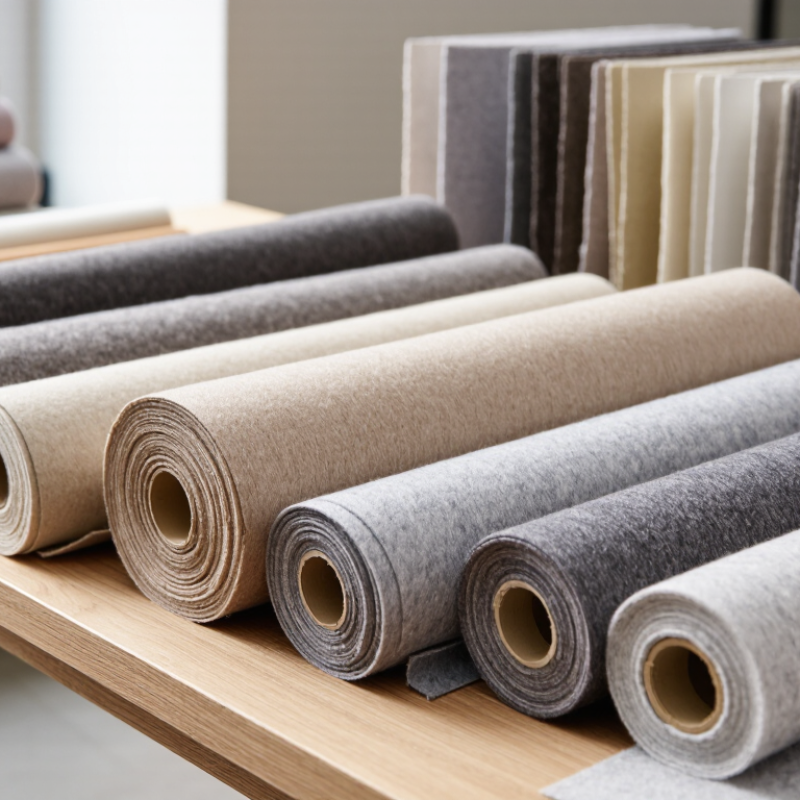
Wool blend felt is a nonwoven material made from wool and other fibers. These may include polyester, viscose, acrylic, or recycled textile fibers. Heat, moisture, and pressure interlock the fibers into a dense sheet. Unlike woven fabric, it has no visible warp or weft. Its surface feels warm, slightly fibrous, and naturally sound-absorbing.
The wool content adds resilience, moisture buffering, and a soft hand feel. Other fibers can improve dimensional stability, color consistency, or cost control. This balance supports global sourcing for acoustic panels, protective inserts, packaging, craft goods, and interior components. According to the International Wool Textile Organisation’s market data, wool represents roughly 1% of global fiber production. Textile Exchange reported that total global fiber production reached about 124 million tonnes in 2023. Wool blend felt therefore serves a specialized market, not a high-volume commodity market.
Specifications still need careful review. Ask suppliers for fiber percentages, thickness tolerance, density, tensile strength, and colorfastness results. Request test methods, not only attractive sample photos. A 2024 supplier audit I observed found small density differences between production lots. That matters when parts must fit tightly. Wool blend felt is not automatically sustainable. Blended fibers can complicate recycling, while recycled content may vary in cleanliness and performance. The European Environment Agency and Textile Exchange both emphasize traceability and reliable material data. Check origin records, certification scope, and batch reports before scaling an order. Some “eco” claims remain too vague.
A practical sourcing reference for composition, performance, processing, and common applications.
| Data Dimension | Typical Information | Why It Matters for Global Sourcing | Recommended Specification Check |
|---|---|---|---|
| Material Definition | A nonwoven felt made by mechanically interlocking fibers, typically combining wool with a manufactured fiber such as polyester or rayon. | The blend balances wool’s natural resilience and warmth with improved consistency, durability, or cost control. | Request the exact fiber percentages and identify whether the blend is by weight or another measurement basis. |
| Common Blend Ratios | 30/70 wool/manufactured fiber; 50/50 balanced blend; 70/30 wool/manufactured fiber. | Higher wool content generally increases natural character, warmth, and moisture buffering, while higher manufactured-fiber content can improve abrasion resistance and dimensional consistency. | Choose the ratio according to the required appearance, hand feel, durability, sustainability objectives, and budget. |
| Manufacturing Method | Needle-punched, pressed, or resin-bonded constructions are commonly used. The process affects density, surface texture, flexibility, and edge behavior. | Manufacturing method influences cutting performance, acoustic response, and suitability for shaped or layered parts. | Confirm the process, surface finish, bonding agent, and whether the product is suitable for die cutting, laser cutting, or CNC routing. |
| Available Thickness | Commercial felt is commonly supplied in thin sheet formats through several-millimeter industrial grades; exact ranges vary by manufacturer and construction. | Thickness affects cushioning, sound absorption, stiffness, thermal resistance, and finished-part dimensions. | Specify nominal thickness plus allowable tolerance, measured under a defined pressure and test method. |
| Density | Density varies significantly with fiber type, needle-punching level, compression, and binder content. | Density is often more useful than thickness alone when comparing weight, firmness, acoustic behavior, and compression performance. | Request density in kg/m³ together with the test method and conditioning environment. |
| Weight | Surface weight is normally reported in g/m² and depends on thickness and density. | It supports freight calculations, material planning, and comparison between samples with similar dimensions. | Define the target g/m² and acceptable tolerance; verify it using a representative production sample. |
| Thermal Behavior | Wool fibers naturally trap air and can provide useful insulation. Performance depends on thickness, density, moisture, compression, and surrounding materials. | Suitable for many protective, interior, and insulation-related applications, but it should not be assumed to replace a certified high-temperature insulation material. | Request thermal conductivity or thermal resistance data at the intended temperature and humidity range. |
| Acoustic Performance | Porous felt can absorb a portion of reflected sound, particularly when used with suitable thickness, air gaps, or backing systems. | It is commonly considered for wall panels, ceiling elements, partitions, office accessories, and equipment enclosures. | Ask for sound absorption coefficients or an equivalent laboratory test, including the mounting condition. |
| Moisture Response | Wool can absorb and release moisture vapor, while liquid water may cause swelling, staining, or changes in shape depending on construction and treatment. | Moisture behavior affects storage, shipping, outdoor use, and dimensional stability. | Confirm moisture regain, water-repellent treatment if required, drying guidance, and packaging for humid transit routes. |
| Abrasion and Recovery | Wool has natural crimp and resilience; manufactured fibers can improve wear resistance and recovery from repeated handling or compression. | Blend selection helps match the felt to protective pads, furniture components, display materials, and industrial liners. | Specify abrasion, compression-set, tear, and tensile requirements based on the final application. |
| Flammability Consideration | Wool is naturally less readily ignited than many common textile fibers, but wool blend felt is not automatically flame resistant. The full blend and any finish determine performance. | Fire performance is application-specific and may be regulated in interiors, transport, construction, and electrical products. | Request a test report to the required local or international standard for the finished construction, not only the raw fiber. |
| Color and Surface | Available surfaces may be natural, dyed, laminated, printed, brushed, smooth, or textured. Wool can provide a soft, natural visual effect. | Appearance consistency is important for retail interiors, furniture, packaging, acoustic products, and architectural components. | Approve a color standard and physical sample; define acceptable variation, pilling level, visible fibers, and surface defects. |
| Cutting and Fabrication | Felt can generally be cut, die-cut, stitched, glued, laminated, or mechanically fastened. The best process depends on thickness, density, and binder content. | Fabrication compatibility can reduce secondary processing time and material waste. | Test edge quality, fraying, odor, smoke, discoloration, and dimensional change after the selected cutting or bonding process. |
| Sourcing Advantages | Wool blend felt can offer a balance of natural fiber content, functional performance, design flexibility, and potentially lower cost than a high-wool construction. | A blended specification can provide more supply options while avoiding dependence on a single fiber type or narrow material grade. | Compare total landed cost, minimum order quantity, lead time, yield, packaging volume, and quality consistency—not only unit price. |
| Quality-Control Items | Key checks include fiber composition, thickness, density, surface weight, color, odor, moisture condition, tensile strength, and dimensional stability. | Clear inspection criteria reduce variation between samples, production lots, and different sourcing regions. | Use a written technical data sheet, approved reference sample, sampling plan, and lot-traceability requirement. |
| Storage and Packaging | Store felt clean, dry, flat or properly rolled, protected from dust, direct sunlight, excessive humidity, and compression damage. | Correct packaging helps preserve color, loft, shape, and surface quality during international transportation. | Define roll direction, moisture-barrier packaging, carton or pallet requirements, labeling, and maximum storage conditions. |
Wool blend felt begins with carefully selected wool fibers and compatible synthetic fibers. Wool contributes warmth, resilience, and a naturally textured surface. Synthetic fibers can improve strength, color consistency, and production stability. The exact ratio depends on the intended use, thickness, and required handling performance.
Manufacturing starts with opening and blending the fibers evenly. Uneven blending can create weak patches, so operators check the mixture during production. Carding then separates and aligns the fibers into a soft web. Several webs may be layered to reach the planned weight. Needling pushes barbed needles through the layers, locking the fibers together without conventional weaving. Heat, moisture, and controlled pressure can further tighten the felt structure. Some materials receive trimming, brushing, dyeing, or surface treatment afterward.
Quality control should examine thickness, density, color, edge stability, and tensile behavior. Samples are often tested before bulk production begins. Small differences matter. A minor density variation can affect cutting accuracy or acoustic performance. Wool blend felt is not perfectly uniform, and that is sometimes overlooked. Natural wool fibers may respond differently to humidity and processing conditions. Export buyers should request production samples, measurement tolerances, fiber composition data, and packaging details. These records make supplier comparisons more reliable, although they cannot replace physical inspection.
How Wool Blend Felt Is Manufactured: wool and selected fibers are opened, blended, formed into a web, consolidated by needle punching, and finished to the required thickness and density.
The chart compares typical moisture regain at standard textile testing conditions of approximately 21°C and 65% relative humidity. Wool has substantially higher moisture regain than common synthetic fibers, helping wool-blend felt provide a balanced combination of comfort, moisture buffering, and dimensional stability. Values are representative midpoints of commonly reported fiber ranges; actual performance depends on fiber ratio, finish, thickness, and manufacturing method.
Why Choose Wool Blend Felt for Global Sourcing?
Wool blend felt offers a practical balance of warmth, resilience, and visual texture. In sourcing projects, it can soften noise inside panels, cases, and interior fixtures. Its dense fibers also help resist light abrasion during repeated handling. It feels substantial. That tactile quality can improve perceived product value without adding complex construction.
Performance depends on the fiber ratio, thickness, density, and finishing process. Wool can support natural moisture buffering and thermal insulation, while synthetic fibers may improve dimensional stability and reduce production variation. A well-made blend can be easier to cut, stitch, or shape than pure wool felt. It may also offer more predictable color matching across batches. Not always. Some blends pill, compress, or change shade under heavy friction.
Reliable global sourcing requires more than reviewing a swatch. Request thickness tolerance, weight per square meter, fiber content, colorfastness, and shrinkage data. Test samples after cutting, bending, moisture exposure, and repeated contact. I have seen attractive felt fail because its edge frayed during assembly. That small detail delayed production. Suppliers should provide consistent technical records and clear inspection methods. Buyers should still verify claims independently, especially when performance requirements are strict. The best choice is not the softest sample, but the blend that matches the product’s actual use.
Why Choose Wool Blend Felt for Global Sourcing?
Wool blend felt suits global sourcing because it balances natural performance with manufacturing consistency. Wool contributes warmth, resilience, and a soft surface. Blended fibers can improve dimensional stability, color consistency, and resistance to daily wear. The exact blend matters. A decorative panel, protective pad, and craft component may need different fiber ratios, densities, and finishes.
Practical sourcing starts with a clear specification sheet. Include fiber content, felt thickness, weight per square meter, roll width, color tolerance, edge finish, and packaging requirements. Request pre-production samples, not only small swatches. A full-width sample may reveal needle marks, uneven density, or curling edges. Testing should cover shrinkage, rubbing fastness, odor, and tensile behavior when relevant. These details help buyers compare suppliers across regions using the same measurements.
Wool blend felt is also easier to plan when suppliers provide batch records and inspection reports. Consistent rolls can reduce cutting waste during furniture, acoustic, packaging, or interior projects. However, consistency is never automatic. Natural wool can vary slightly between batches, and low-cost blends may feel harsher than expected. We once treated color matching as a simple approval step; lighting differences later exposed the weakness. Better practice uses physical standards, defined tolerances, and photographs under controlled light. Packaging deserves attention too. Moisture-resistant wrapping and labeled rolls help protect material during long-distance transport.
Wool blend felt combines natural fiber character with improved consistency from synthetic fibers. Its texture, density, and resilience suit acoustic panels, desk accessories, packaging inserts, and interior displays. However, “wool blend” is not a complete specification. Buyers should request the exact fiber ratio, felt thickness, weight per square meter, color tolerance, and edge finish. Details matter.
During supplier evaluations, ask for production samples from different batches. Compare surface evenness, compression recovery, odor, and cutting performance. A reliable supplier should provide test reports, material traceability, clear tolerances, and realistic lead times. Factory capacity also matters during seasonal demand. I have found that a polished sample can hide inconsistent bulk production. This is easy to miss. Request a pre-production approval sample and define inspection points before ordering.
Tips: Match the felt to its application. Dense felt can support dividers and protective pads, while softer grades may suit decorative panels. Check moisture exposure, cleaning methods, fire requirements, and indoor air standards for the destination market. Ask whether colors remain stable under expected lighting. Test both. Also review packaging, carton strength, labeling, and moisture protection. A supplier offering the lowest quotation may create higher costs through waste, delays, or repeated inspections. Reflect on the full sourcing risk, not only the unit price.
We use cookies on our website to give you an improved browser experience. View our Privacy Policy for more information. Please make your selection to opt in or out of ALL cookies here: Accept or Decline
Do you consent to the use of ALL cookies?
901 2nd Court West
Birmingham, AL 35204
Sales: 866.481.4036
Logistics/Ops: 866.481.4036
2101 Dralle Road
University Park, IL 60466
Sales: 708.813.9070
Logistics/Ops: 708.235.4200
400 E. 13th Street
Little Rock, AR 72114
Sales: 866.760.5344
Logistics/Ops: 866.760.5344
225 Collins Road
Elkhart, IN 46515
Sales: 574.295.0214
Logistics/Ops: 574.607.4611
601 Berryman Pike
Tipton, IN 46072
Sales: 800.897.7591
Logistics/Ops: 800.897.7591
3900 Uvalda Street
Denver, CO 80239
Sales: 303.706.8000
Ops/Logistics: 303.576.8398
510 3rd Street E
Milan, IL 61264
Sales: 800.322.1052
Logistics/Ops: 800.322.1052
1660 E. Aurora
Des Moines, IA 50313
Sales: 800.671.1660
Logistics: 800.671.1660
86554 Gene Lasserre Blvd.
Yulee, FL 32097
Sales: 904.253.3060
Logistics/Ops: 904.225.3000
694 S.E. County Road 245
Lake City, FL 32025
Sales: 800.727.6706
Logistics/Ops: 386.752.7412
210 Neptune Road
Auburndale, FL 33823
Sales: 863.967.1131
Logistics/Ops: 863.777.9814
4601 McCoy Drive
Pensacola, FL 32503
Sales: 850.308.7030
Logistics/Ops: 850.434.5502
815 South 56th Street
Tampa, FL 33619
Sales: 813.302.1940
Logistics/Ops: 813.621.1352
200 Hosea Road
Lawrenceville, GA 30046
Sales: 770.953.7575
Logistics/Ops: 770.513.6000
Branch Product Guide
Branch Line Card
Moulding Offering
Cedar Offering
Column Offering
8173 Hwy. 165 North
Monroe, LA 71211
Sales: 800.256.4165
Logistics/Ops: 800.256.4165
508 Warren Avenue
Portland, ME 04103
Sales: 207.888.2331
Logistics/Ops: 207.797.6565
4300 Georgia Pacific Blvd.
Frederick, MD 21704
Sales: 301.798.7474
Logistics/Ops: 301.874.8000
419 Maple Street
Bellingham, MA 02019
Sales: 508.449.0535
Logistics/Ops: 508.966.5500
825 Buchanan Ave SW
Grand Rapids, MI 49507
Sales: 877.800.1180
Logistics/Ops: 616.278.0909
995 Pacific St. NW
Aitkin, MN 56431
Sales: 800.432.3727
Logistics/Ops: 218.212.7770
1102 Port Terminal Drive
Duluth, MN 55802
Sales: 800.951.9899
Logistics/Ops: 800.851.9899
9110 83rd Ave. North
Brooklyn Park, MN 55445
Sales: 763.425.0204
Logistics/Ops: 763.425.0204
910 E. Railroad Street
Long Beach, MS 39560
Sales: 866.535.4135
Logistics/Ops: 228.205.2400
1727 Warren Street
North Kansas City, MO 64116
Sales: 800.621.2611
Logistics/Ops: 800.621.2611
2123 North Golden
Springfield, MO 65803
Sales: 800.375.7891
Logistics/Ops: 800.375.7891
13860 Corp. Woods Trail
Bridgeton, MO 63044
Sales: 314.209.0800
Logistics/Ops: 314.209.0800
1109 South 19th Street
Omaha, NE 68108
Sales: 800.489.6637
Logistics/Ops: 800.489.6637
1 Luger Road
Denville, NJ 07834
Sales: 973-339-3539
Logistics/Ops: 973.625.1461
3720 Jeffrey Blvd.
Blasdell, NY 14219
Sales: 716.235.5989
Logistics/Ops: 716.825.6557
319 Yaphank Ave.
Yaphank, NY 11980
Sales: 631.358.5714
Logistics/Ops: 631.924.7401
3300 Parkside Drive
Charlotte, NC 28208
Sales: 800.839.2588
Logistics/Ops: 704.394.3172
1712 East D Street
Butner, NC 27509
Sales: 984.389.8200
Logistics/Ops: 919.575.3700
128 Foothills Drive
Statesville, NC 28687
Sales: 800.222.1414
Logistics/Ops: 704.394.3172
550 Munroe Falls Rd.
Tallmadge, OH 44278
Sales: 330.357.4506
Logistics/Ops: 330.794.1141
10347 Toebben Dr.
Independence, KY 41051
Sales: 859.298.3926
Logistics/Ops: 859.746.2250
450 N. MacArthur
Oklahoma City, OK 73127
Sales: 800.375.6025
Logistics/Ops: 800.375.6025
1680 North Aspen
Broken Arrow, OK 74012
Sales: 918.272.2212
Logistics/Ops: 918.272.2212
522 Bridge Street
Hunker, PA 15639
Sales: 878.217.2001
Logistics/Ops: 724.925.7285
4290 Atlanta Street
Charleston, SC 29418
Sales: 843.371.1420
Logistics/Ops: 843.554.8192
1040 S. Industrial Dr.
Erwin, TN 37650
Sales: 423.641.1005
Logistics/Ops: 423.742.5911
4287 Pilot Drive
Memphis, TN 38118
Sales: 901.365.2101
Logistics/Ops: 901.365.2101
700 Myatt Drive
Madison, TN 37115
Sales: 615.327.9547
Logistics/Ops: 629.777.4949
4747 Mark IV Parkway
Fort Worth, TX 76106
Sales: 866.323.5117
Logistics/Ops: 817.625.9091
6990 Market Avenue
El Paso, TX 79915
Sales: 915.778.6356
Logistics/Ops: 915.265.7200
2502 Wilson Road
Harlingen, TX 78552
Sales: 800.580.6711
Logistics/Ops: 800.580.6711
10,000 North Loop East
Houston, TX 77029
Sales: 713.921.1977
Logistics/Ops: 713.675.3544
702 East 44th St.
Lubbock, TX 79404
Sales: 866.454.6010
Logistics/Ops: 866.454.6010
535 N. WW White Road
San Antonio, TX 78219
Sales: 800.284.0488
Logistics/Ops: 210.333.8112
142 Pine Haven Shores Rd.
Shelburne, VT 05482
Sales: 802.800.2540
Logistics/Ops: 802.985.2512
4700 Bethlehem Road,
Richmond, VA 23230
Sales: 804.201.2400
Logistics/Ops: 804.342.1161
4516 N Barker Road
Spokane Valley, WA 99027
Phone: 509.892.9420
Toll free: 800.728.6157
8365 N. 76th Street
Milwaukee, WI 53223
Sales: 800.356.9245
Logistics/Ops: 800.356.9245
312 S. Chester Street
Sparta, WI 54656
Sales: 800.362.5864
Logistics/Ops: 800.362.5864
899 Grossman Drive
Schofield, WI 54476
Sales: 800.472.0017
Logistics/Ops: 800.472.0017
